General
Step Geometry
Adhesive
Adherends
Overlap length
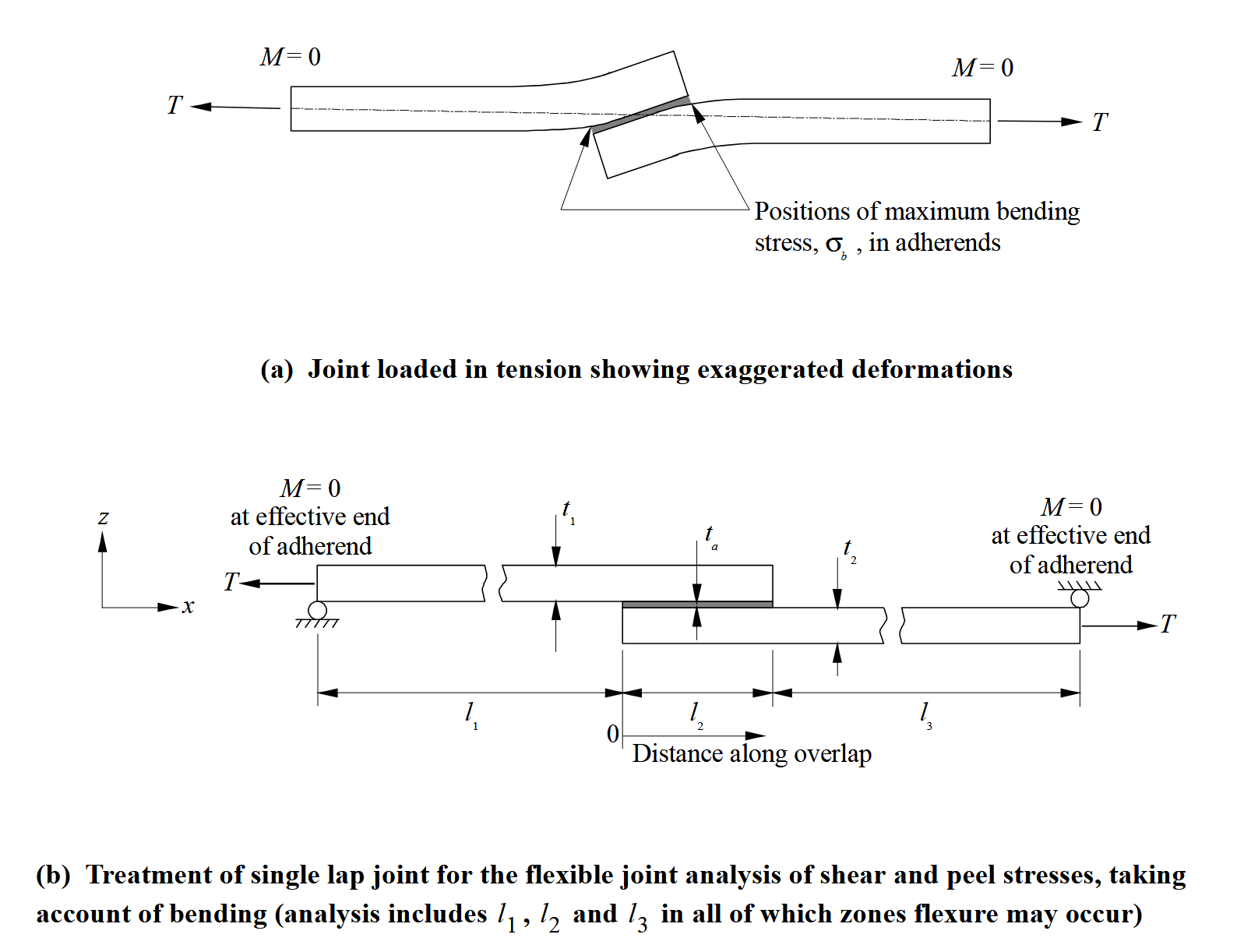
'Free lengths'
You can specify values for the free lengths or you can use the default of 6 times the overlap length.
See the sketch on the 'Overview' tab for details.
Adhesive Properties
Shear modulus
Adherend Properties
Adherend 1:
Adherend 2:
Loading
Tensile loading
Thermal loading
Optimisation
Conditions
An optimisation analysis was performed for these conditions:
| Parameter | Fixed value | Min value | Max value | Units | |
|---|---|---|---|---|---|
| Overlap length | {{occ.oodleCore.utils.valPrintFormatted(tba.opttable.step.length.value, 'p', 4)}} - | - {{occ.oodleCore.utils.valPrintFormatted(tba.opttable.step.length.value, 'p', 4)}} | - {{occ.oodleCore.utils.valPrintFormatted( tba.opttable.step.length.value + tba.opttable.step.delta_l.value, 'p', 4) }} | ||
| Adhesive shear modulus | {{occ.oodleCore.utils.valPrintFormatted(tba.opttable.adhesive.material.G.value, 'p', 5)}} - | - {{occ.oodleCore.utils.valPrintFormatted(tba.opttable.adhesive.material.G.value, 'p', 5)}} | - {{occ.oodleCore.utils.valPrintFormatted( tba.opttable.adhesive.material.G.value + tba.opttable.adhesive.delta_G.value, 'p', 5) }} | ||
| Adhesive elastic modulus* | {{occ.oodleCore.utils.valPrintFormatted(tba.opttable.E.min, 'p', 5)}} - | - {{occ.oodleCore.utils.valPrintFormatted(tba.opttable.E.min, 'p', 5)}} | - {{occ.oodleCore.utils.valPrintFormatted(tba.opttable.E.max, 'p', 5)}} | ||
|
* Adhesive elastic modulus is calculated using the relationship (where = {{occ.oodleCore.utils.valPrintFormatted(tba.ep.o.esducalc.inputdata.joint.lapjoint.adhesivelapjoint.components.adhesive.material.nu.value, 'p', 4)}}) |
|||||
| Parameter | Value | Source |
|---|---|---|
| Pre-overlap free length () | {{occ.oodleCore.utils.valPrintFormatted(tba.ep.o.esducalc.inputdata.joint.lapjoint.geometry.zone_pre.free_length.value, 'p', 4)}} | User specified default of 6 × step length |
| Post-overlap free length () | {{occ.oodleCore.utils.valPrintFormatted(tba.ep.o.esducalc.inputdata.joint.lapjoint.geometry.zone_post.free_length.value, 'p', 4)}} | User specified default of 6 × overlap length |
Optimum Results
| Parameter | Value | Units | |
|---|---|---|---|
Length
Table of maximum adhesive shear stress and maximum peel stress versus overlap length at a shear modulus of {{occ.oodleCore.utils.valPrintFormatted(tba.os.stress_analysis_results.flexible.optimisations.optimum_shear_modulus.value, 'p', 5)}}
|
|
|
|
|---|---|---|
| {{occ.oodleCore.utils.valPrintFormatted(trow[0], 'p', 5)}} | {{occ.oodleCore.utils.valPrintFormatted(trow[1], 'p', 5)}} | {{occ.oodleCore.utils.valPrintFormatted(trow[2], 'p', 5)}} |
Shear modulus
Table of maximum adhesive shear stress and maximum peel stress versus adhesive shear modulus at an overlap length of {{occ.oodleCore.utils.valPrintFormatted(tba.os.stress_analysis_results.flexible.optimisations.optimum_length.value, 'p', 4)}}
|
|
|
|
|---|---|---|
| {{occ.oodleCore.utils.valPrintFormatted(trow[0], 'p', 5)}} | {{occ.oodleCore.utils.valPrintFormatted(trow[1], 'p', 5)}} | {{occ.oodleCore.utils.valPrintFormatted(trow[2], 'p', 5)}} |
Main Results
Graph
Plot
Table
Key
Table
| {{occ.oodleCore.utils.valPrintFormatted(trow[0], 'p', 4)}} | {{occ.oodleCore.utils.valPrintFormatted(trow[1], 'p', 5)}} | {{occ.oodleCore.utils.valPrintFormatted(trow[2], 'p', 5)}} | {{occ.oodleCore.utils.valPrintFormatted(trow[3], 'p', 5)}} | {{occ.oodleCore.utils.valPrintFormatted(trow[4], 'p', 5)}} | {{occ.oodleCore.utils.valPrintFormatted(trow[5], 'p', 5)}} | {{occ.oodleCore.utils.valPrintFormatted(trow[6], 'p', 5)}} |
Deformation
Graph
Plot
Tables of rotations and displacements
Pre-overlap zone
| , | , | , |
|---|---|---|
| {{occ.oodleCore.utils.valPrintFormatted(trow[0], 'p', 4)}} | {{occ.oodleCore.utils.valPrintFormatted(trow[1], 'p', 5)}} | {{occ.oodleCore.utils.valPrintFormatted(trow[2], 'p', 5)}} |
Overlap zone
| , | , | , | , | , |
|---|---|---|---|---|
| {{occ.oodleCore.utils.valPrintFormatted(trow[0], 'p', 4)}} | {{occ.oodleCore.utils.valPrintFormatted(trow[1], 'p', 5)}} | {{occ.oodleCore.utils.valPrintFormatted(trow[2], 'p', 5)}} | {{occ.oodleCore.utils.valPrintFormatted(trow[3], 'p', 5)}} | {{occ.oodleCore.utils.valPrintFormatted(trow[4], 'p', 5)}} |
Post-overlap zone
| , | , | , |
|---|---|---|
| {{occ.oodleCore.utils.valPrintFormatted(trow[0], 'p', 4)}} | {{occ.oodleCore.utils.valPrintFormatted(trow[1], 'p', 5)}} | {{occ.oodleCore.utils.valPrintFormatted(trow[2], 'p', 5)}} |
Summary
This ESDU Toolbox app for ESDU 92041 analyses the distribution of the stresses and strains in the adhesive of a bonded single lap joint under an applied load, together with the nominal stresses in the adherends.
Section 1 of ESDU 92041 describes the theory and application of two, alternative, analyses of a single-step lap joint.
This program implement the second analysis, the 'flexible' analysis, is applicable to single lap joints loaded in tension and takes account of bending of the joint in deriving the peel stresses resulting from that bending. This analysis also takes account of thermal stresses arising as a result of differences between joint working temperature and curing temperature, but it does not allow for the inelastic shear stress-strain properties of the adhesive.
The 'simple shear stress' analysis is implemented in the ESDU Toolbox App, ESDU 92041 - simple analysis.
It is assumed that the behaviour of the plate material, the adherend, is elastic and any stress concentrations are ignored.
This ESDU Toolbox App is intended for use in achieving a good, well-balanced design; to this end the program is equipped with a facility whereby it can find the overlap length and/or adhesive shear modulus that give the lowest maximum adhesive shear stress for a particular joint. It is emphasised, however, that the program can only accurately predict the behaviour of a joint if good material property data are available.
DEBUG
{{tba | json}}