General
Fixed Geometry of Aerofoil with Single-slotted Flap
Case for Single-slotted Flap Geometry
Summary
This app provides the increment in profile drag coefficient due to the deployment of a single-slotted flap on an aerofoil at zero incidence.
The method is based on data where the flap slot was optimised for the purpose of maximising lift coefficient at the stall. The method applies at low speeds and does not apply if any leading-edge device is also deployed.
Using the limited number of experimental data available in the literature, a correlation method was developed which produced Figure 1 in ESDU 87005, giving the variation of the increment with flap deflection angle and the ratio of the extended chord (due to flap deployment) to the basic aerofoil chord (with flap retracted). Figure 1 applies to aerofoils with maximum camber position between 0.2 and 0.65 of chord, and predicts the drag increment to within 20%.
The position of maximum camber was found to have a significant effect on the increment in profile drag coefficient. In the Data Item, Figure 2 (for maximum camber at 0.15 chord) and Figure 3 (for maximum camber positioned between 0.7 and 0.8 of chord), illustrate the trends with aerofoil and flap deployment geometry.
Note: The user should consult ESDU 87005 for full specification and discussion of the aerofoil/single-slotted flap configurations and flow conditions covered by the data used in the derivation of the method, and additional advice on the applicability.
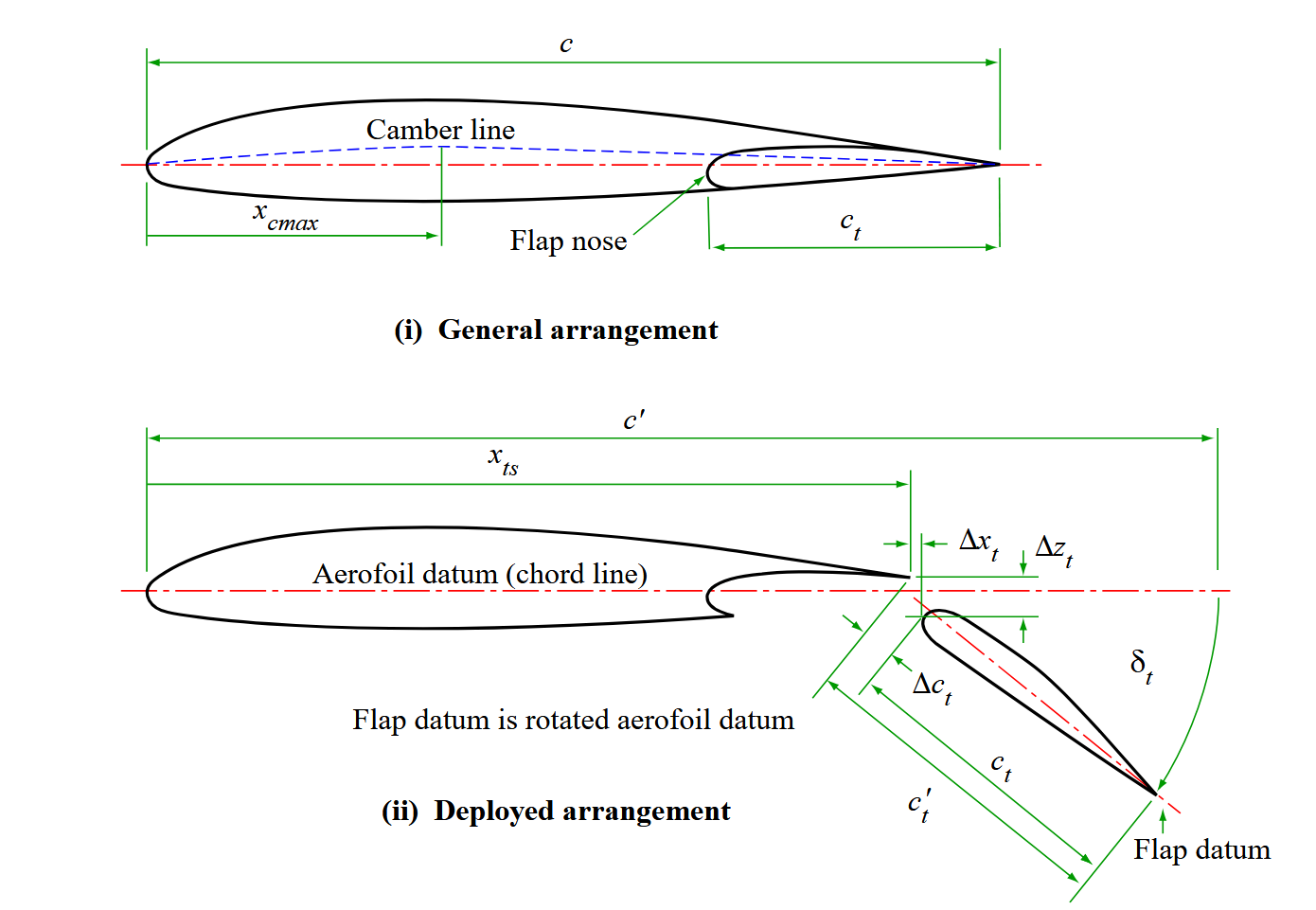
Geometry
DEBUG
{{tba | json}}