General
Step Geometry
| Step | Length {{tba.ep.i.inputdata.joint.lapjoint.geometry.zone_in.overlap.steps[0].length.units_display}} |
Adherend 1 thickness {{tba.ep.i.inputdata.joint.lapjoint.geometry.zone_in.overlap.steps[0].adherend1_thickness.units_display}} |
Adherend 2 thickness {{tba.ep.i.inputdata.joint.lapjoint.geometry.zone_in.overlap.steps[0].adherend2_thickness.units_display}} |
|
|---|---|---|---|---|
Adhesive
Adhesive geometry
Adhesive properties
for an elastic analysis:
for an inelastic analysis:
Loading and Adherend Properties
for tensile loading:
Adherend 1 properties:
Adherend 2 properties:
for shear loading:
Adherend 1 properties:
Adherend 2 properties:
Graph
, = {{occ.utils.valPrintPrecision(tba.os.total_overlap_length.value, 3)}}
Plot
Step data
Key
| Note: values of '' that exceed the maximum allowable shear strain in the adhesive are presented in the Results tables, below, in italics. | ||
{{tstep.note}}
| {{occ.oodleCore.utils.valPrintFormatted(trow[0], 'p', 3)}} | {{occ.oodleCore.utils.valPrintFormatted(trow[1], 'p', 5)}} | {{occ.oodleCore.utils.valPrintFormatted(trow[2], 'p', 5)}} | {{occ.oodleCore.utils.valPrintFormatted(trow[3], 'p', 5)}} | {{occ.oodleCore.utils.valPrintFormatted(trow[4], 'p', 5)}} |
Summary
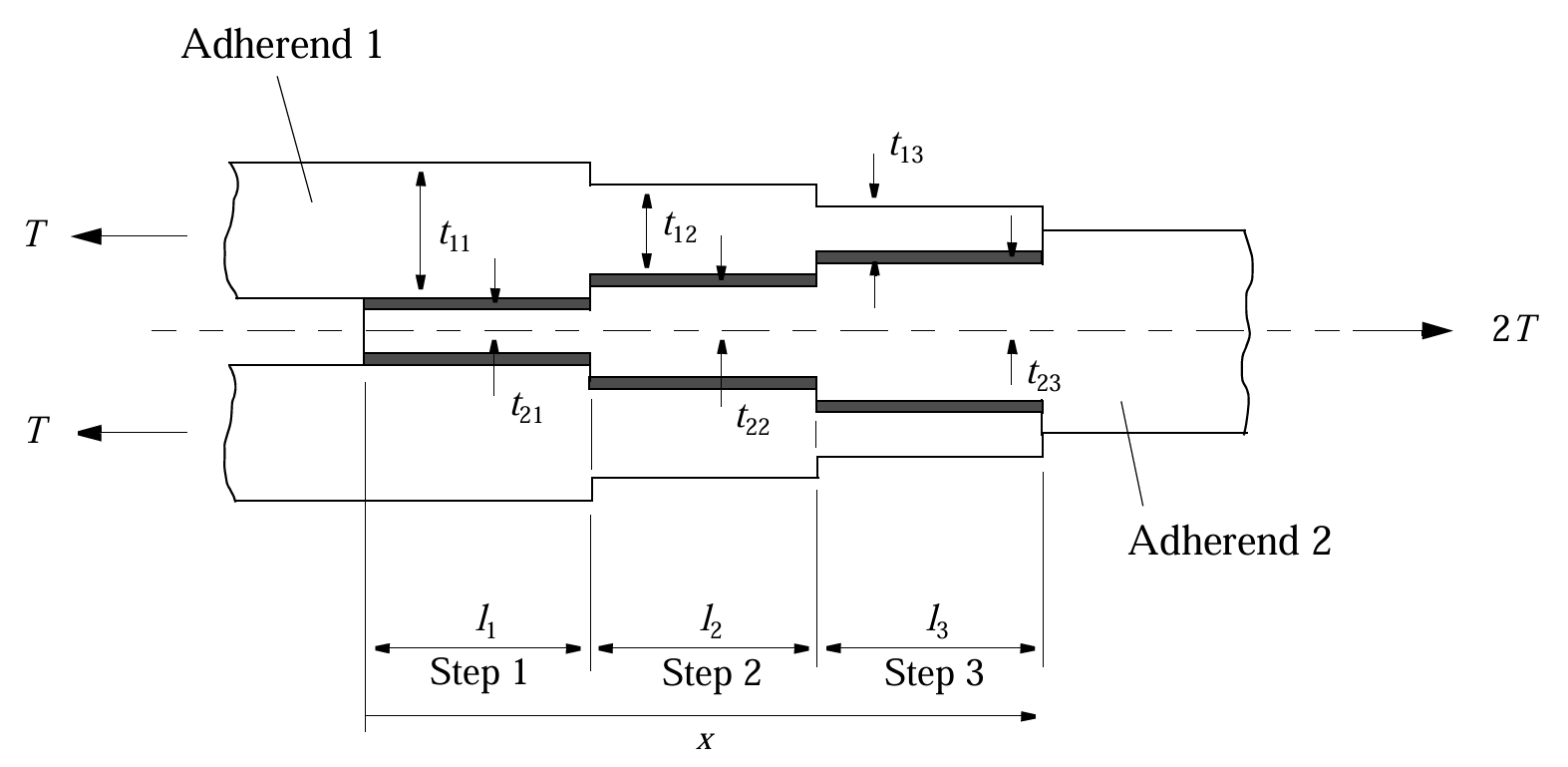
This ESDU Toolbox app for ESDU 79016 analyses the distribution of the shear stresses and strains in the adhesives that bond lap joints of multi-step configuration loaded in either tension or shear.
The analysis can be applied to either single or double lap joints provided that the latter are symmetric. The app allows for the inelastic shear stress-strain properties of the adhesive and assumes that the behaviour of the adherend material is elastic. The app is applicable to joints made of orthotropic materials, such as composites, provided that the appropriate moduli are used. The method does not take into consideration the effect of bending in the joint and it ignores the local stress concentrations in the adherends.
Section 1 of ESDU 79016 describes the theoretical solution and its application to practical bonded joints. The section includes figures that illustrate the influence of geometrical and material properties on the shear stresses and strains in the adhesive. The analysis determines the distribution of shear stress in the adhesive that results from the transmission of the in-plane tensile or shear loads from one adherend to the other via the adhesive. The analysis takes account of the inelastic shear stress-strain characteristics of the adhesive. It assumes that the adherends behave elastically and are flexurally rigid. It does not therefore consider the effect on the adhesive or the adherends of through-the-thickness (peel) stresses or of bending effects that may result either from the transmission of the load from one adherend to the other or from external bending moments. The effects of these factors are discussed in ESDU 80039 and ESDU 17004.
DEBUG
{{tba | json}}